





Common Applications of Lifting Hooks in Industrial Handling
 Jun 25, 2026|
Common Applications of Lifting Hooks in Industrial Handling
Lifting hooks are one of the most important connection components in crane, hoist, rigging and material handling systems. A hook links the lifting equipment with wire rope, chain slings, webbing slings, shackles or lifting beams, allowing heavy loads to be raised, positioned and transferred safely. In many lifting systems, the hook is the final load-bearing point, so its design, material and condition directly affect lifting safety.

Crane hook pulley assemblies are commonly used in heavy-duty wire rope lifting systems.
1. Manufacturing workshops and machinery handling
In workshops, foundries and machinery plants, lifting hooks are widely used with overhead cranes, jib cranes, gantry cranes and electric hoists. They help operators lift steel plates, molds, motors, gearboxes, machine frames and other heavy components. Compared with fixed lifting points, hooks provide flexible connection and quick attachment, which improves handling efficiency during production and maintenance.
2. Construction and steel structure installation
Construction sites also rely on lifting hooks for moving steel beams, precast concrete parts, pipes, formwork and temporary equipment. When used with tower cranes or mobile cranes, the hook must match the sling angle, load weight and lifting method. For site operations, hooks with a reliable safety latch help reduce the risk of accidental disengagement when the load swings or when the working environment is crowded.
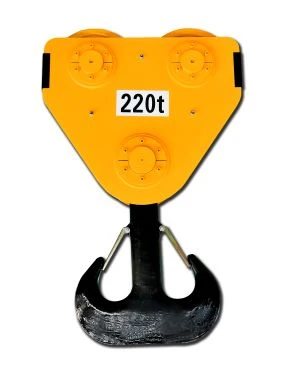
Double hook blocks are often selected for high-capacity lifting and large industrial components.
3. Ports, shipyards and logistics operations
In ports, shipyards and warehouses, lifting hooks are used for loading, unloading and short-distance transfer of bulky goods. They may work together with spreader beams, chain slings, wire rope slings or special lifting fixtures. For marine and outdoor environments, corrosion resistance, surface treatment and regular inspection are especially important because moisture and frequent use can accelerate wear.
4. Hoist, pulley block and rigging systems
Many hook blocks include pulley sheaves to guide wire rope and increase lifting capacity. These assemblies are used in cranes, winches, chain blocks and custom lifting systems. The hook opening, swivel function, sheave structure and bearing quality should be considered together, because each part influences load stability and operating smoothness.

Rotating hooks and safety latch designs help improve flexibility and load security in hoisting operations.
Key points for selecting lifting hooks
When choosing a lifting hook, users should first confirm the working load limit and the type of load being handled. The hook should be compatible with the sling or attachment, and the throat opening should be suitable for the connection hardware. For heavy-duty or frequent lifting, forged steel hooks are often preferred because they offer good strength and toughness. A safety latch, proper heat treatment, clear load marking and stable surface protection are also important selection factors.
Inspection and safe use
A lifting hook should never be overloaded, side-loaded or used with the load applied to the hook tip. Before use, operators should check for cracks, deformation, severe wear, an enlarged throat opening and a damaged or missing latch. If any abnormal condition is found, the hook should be removed from service immediately. Regular inspection and correct operation help extend service life and reduce lifting risks.
Conclusion
Although lifting hooks may look simple, they are critical to the safety and efficiency of lifting operations. From manufacturing workshops to construction sites, ports and hoist systems, the right hook helps ensure stable connection, smoother handling and safer industrial lifting. Selecting quality hooks according to the actual working condition is an important step for every lifting equipment user.